
Why Your Illinois Cool-Season Lawn Browns in July: Heat Dormancy vs Drought vs Disease
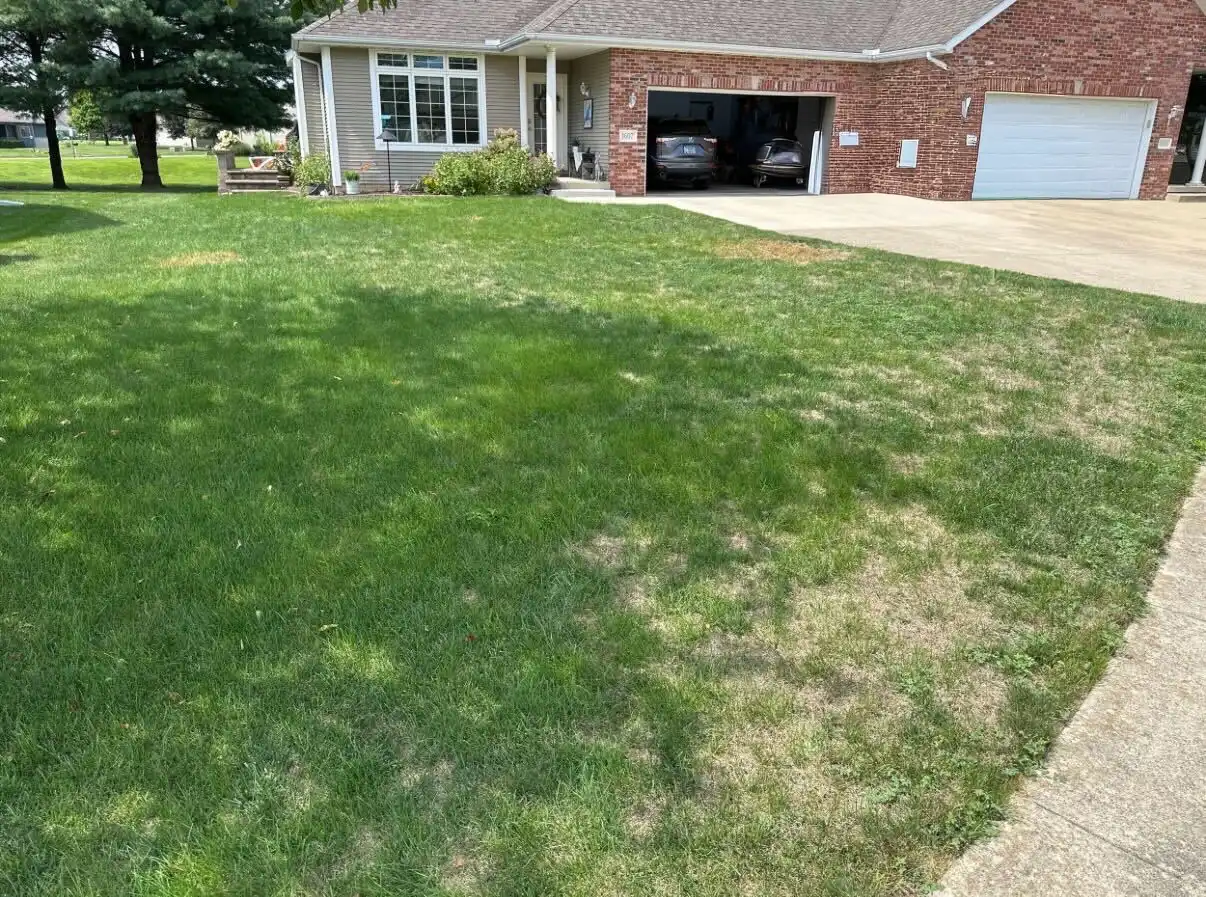
Short Answer: A Northern Illinois lawn that browns in July is doing one of three things and the right response is completely different for each. Heat dormancy is a normal protective shutdown of Kentucky bluegrass and fescue when soil temperatures climb above 80 degrees, the crowns are alive, and the lawn will recover in September with no intervention. Drought stress looks similar but the crowns are actively losing tissue and a single deep watering will stop the decline. Disease is uneven, has visible patterns, and needs treatment within days, not weeks. We walk a stressed July lawn and look at five clues to tell them apart before we recommend a single dollar of work.
The phone calls start in the first week of July every year. The lawn looked great over Memorial Day. By the Fourth of July there are tan and brown patches across the front yard and the homeowner is calling to ask what is wrong. We have walked enough Princeton, Spring Valley, Peru, Oglesby, and LaSalle properties through this exact window over the last five decades to know that browning in July is rarely one thing. It is usually one of three patterns, and each pattern needs a different response. Treating heat dormancy like disease wastes money. Treating disease like drought stress wastes the lawn. The first job in July is diagnosis, not treatment.
Our family has been working on lawns in north-central Illinois for over fifty years. The diagnostic walk we run on a stressed July property has not changed much because the underlying biology has not changed. What has changed is how many homeowners reach for a product before they understand the problem. We want to walk through how to tell the three causes apart so you can spend money on what your lawn actually needs.
What Heat Dormancy Looks Like
Heat dormancy is a normal physiological response in cool-season grasses. Kentucky bluegrass, fine fescue, tall fescue, and perennial ryegrass all evolved to grow in cooler conditions than a Northern Illinois July provides. When soil temperatures climb above 80 degrees and stay there for a stretch of days, the plant shuts down top growth, pulls resources into the crown, and waits for fall. The blades brown. The lawn looks dead. The plant is not dead. The crowns are protected at the soil line and the root system is intact.
Dormant turf has a consistent set of clues that distinguishes it from drought or disease. Color is uniform across the affected area. There is no patchwork of green and brown within the same patch. The browning starts at the tips of the blades and works down rather than appearing as defined dead patches. Crowns at the soil line are firm and tan to greenish when you part the canopy with your fingers. Roots are white when you pull a small plug.
A lawn in true heat dormancy will resume growth on its own when soil temperatures drop back into the 70s and adequate moisture returns. In Northern Illinois that usually happens in the first half of September. No watering, no fertilizer, no fungicide will speed it up by more than a few days. The lawn is doing what it evolved to do.
The temptation in mid July is to do something. We understand it. The lawn looks dead and the homeowner wants action. The right action on a truly dormant lawn is restraint. Light maintenance watering of about half an inch every two to three weeks keeps the crowns hydrated enough to recover. Anything more is wasted, and pushing fertility into a dormant lawn causes harm rather than help.
What Drought Stress Looks Like
Drought stress is different. The plant is not protecting itself by going dormant. It is losing tissue because moisture has been below survival threshold for long enough that the crowns themselves are starting to fail. Untreated drought stress on cool-season turf produces real dead patches that do not come back in fall. The line between dormancy and drought damage is roughly four to six weeks of soil moisture below the critical level. Past that, the lawn is no longer asleep. It is dying.
Drought-stressed turf shows a different cluster of signs. The blades take on a blue-gray cast before they brown rather than fading tan from the tips. Footprints linger in the lawn for an hour or more after you walk across it because the blades have lost the turgor pressure that lets them spring back. The browning is uneven, with the worst damage on south and west exposures, along driveway and sidewalk edges where reflected heat is highest, and on any slopes where water runs off rather than soaking in. Crowns feel dry and brittle when you part the canopy. Roots are thin and brown rather than white and full.
The fix for confirmed drought stress is a deep recovery watering followed by a consistent schedule. One inch of water applied in a single early-morning cycle will rehydrate the crowns and stop the decline if the damage has not progressed too far. Then settle into a schedule of two cycles per week, half an inch each, before 8 in the morning, for the rest of July and August.
The catch is that the homeowner has to decide which lawn they have. A genuinely dormant lawn does not need this watering. Forcing water into dormant turf can actually invite disease because the canopy stays wet during conditions that favor fungal activity. The screwdriver test settles it. A long screwdriver should slide into the soil five to six inches with light pressure on a properly hydrated lawn. If it stops at two or three inches and the soil under the brown comes up dry and crumbly, you have drought stress and need water. If the screwdriver goes in easily and the soil is moist below the surface, the lawn is dormant rather than dry.
What Disease Looks Like
Disease is the third pattern and the one that needs the fastest response. Several pathogens become active in Northern Illinois cool-season lawns once nighttime temperatures stay above 65 degrees and dew is heavy through dawn. The big three we see in July are brown patch, dollar spot, and red thread. Pythium and summer patch show up on lawns with longer histories of stress. Each one has visual signatures, and once you know what to look for the diagnosis is usually fast.
Brown patch creates circular dead patches one to three feet across with darker outer rings and a smoke ring of slightly grayer turf at the edge during active morning hours. Walk the lawn between 6 and 8 a.m. while dew is still on the canopy. Active brown patch will show a faint cobwebby growth on the blades at the patch edge. Dollar spot makes silver-dollar-sized circular patches that often merge into larger irregular dead areas. The blades within the patch show hourglass-shaped tan lesions when you look closely. Red thread produces pinkish-red thread-like growths on grass tips and is most common in lawns short on nitrogen.
Disease patches are not uniform like dormancy and they are not exposure-driven like drought. They appear in shaded areas, in low spots where dew lingers, and in zones with poor air movement. The boundary between sick and healthy turf is usually sharp, not gradual. A confirmed disease outbreak in July warrants a fungicide application within a few days. Waiting two weeks usually means a much larger affected area and a longer recovery into fall.
The Five Clues We Use on a Diagnostic Walk
When we walk a stressed lawn in July, the diagnosis usually comes from five observations in the first ten minutes.
First, the pattern. Uniform browning across an entire zone points to dormancy or drought. Defined patches, especially circular ones, point to disease. Geometric dry strips with sharp edges point to irrigation coverage problems.
Second, the color path. Blade tips browning first while the base stays green points to dormancy. A blue-gray cast across the whole blade before browning points to drought. Patches with darker rings or thread-like growths point to disease.
Third, the crown check. We part the canopy and look at the soil line. Firm tan or greenish crowns mean the plant is alive and dormant. Dry brittle crowns mean drought damage is happening. Crowns with discolored lesions or visible fungal growth confirm disease.
Fourth, the screwdriver test. Easy penetration with moist soil below means the lawn has water and is dormant. Resistance and dry soil mean drought. Saturated soil at the surface points to overwatering, which often turns into disease.
Fifth, the exposure map. South and west slopes, edges along hardscape, and bare-soil margins always stress first when the cause is heat or drought. Shaded low spots and densely thatched zones always show disease first. The geography of the damage tells you a lot about the cause.
What Each Diagnosis Costs to Treat
Knowing what you are dealing with also lets you set the right budget. A dormant lawn needs no treatment, just light maintenance watering at most. The cost is essentially zero, and the homeowner who recognizes the diagnosis stops worrying. A drought-stressed lawn needs a recovery watering and a consistent schedule for the rest of summer. The cost is mostly water and time, often under a hundred dollars even on larger lots. A disease outbreak needs a targeted fungicide application, typically in the range of one hundred fifty to three hundred dollars for a residential lot, plus a follow-up walk in two to three weeks to confirm the response. Lawns with chronic disease pressure may need two or three applications spaced across the summer.
The waste is in mismatched treatments. A fungicide on a dormant lawn does nothing and costs the same. A fertilizer on a dormant or drought-stressed lawn often makes the situation worse. A heavy watering on a disease-active lawn accelerates the pathogen. The diagnosis is what makes the dollars work.
What to Do This Week If You Are Not Sure
If you are looking at a browning lawn and not sure which pattern you have, walk it tomorrow morning at dawn while dew is still on the grass. Look for circular patches with darker rings. Look for cobwebby mycelium on the blade tips. Look for the color path on the blades themselves. Use a long screwdriver to test soil moisture in two or three areas, one in the worst-looking spot and one in the best-looking spot. Part the canopy with your fingers and look at the crowns at the soil line.
Most homeowners can reach a confident diagnosis in twenty minutes. If you cannot, that is what we are here for. The diagnostic walk is the most valuable thing we do on a July visit because everything that follows depends on getting the cause right.
Why Mistakes Compound Through August
A misdiagnosed July lawn is much harder to fix in August. Heat dormancy that gets overwatered turns into a disease outbreak because the canopy stays wet during conditions that favor pathogens. Drought stress that gets treated with fungicide rather than water progresses to crown death that does not recover in fall. Disease that gets treated with extra fertilizer flushes growth into infected tissue and spreads the pathogen faster. The cost of being wrong in July is paid in August and September when the lawn either recovers or has to be renovated.
The lawns we see needing fall renovation are very often lawns where a July misdiagnosis led to a wrong treatment that made the situation worse. The lawns that come through summer in good shape are not always the ones that got the most attention. They are the ones that got the right attention.
Frequently Asked Questions
How long can a cool-season lawn stay dormant before it actually dies?
Healthy Kentucky bluegrass and fescue can survive four to six weeks of true dormancy with the crowns intact. Beyond that, prolonged drought stress at the crown level starts producing dead tissue that does not recover. In Illinois, light maintenance watering every two to three weeks during a long dry spell is the cheap insurance policy.
Is brown grass under my walking path dormancy or damage?
Usually compaction and traffic stress, which mimic drought. The crowns get crushed and the soil compresses, so water and oxygen cannot reach the root zone. Aeration in fall is the long-term fix. In the meantime, redirect traffic if possible.
Does mowing affect which of these I see?
Yes. Lawns mowed short stress earlier and harder. A 2-inch cut on Kentucky bluegrass in July exposes crowns to direct sun, raises soil temperature, and pushes the lawn toward dormancy or damage. Raise the deck to 3.5 to 4 inches through summer.
Should I fertilize a stressed lawn in July?
No on heat-stressed cool-season grass. Save the next feeding for early September when conditions favor recovery. Pushing nitrogen into a stressed July lawn produces soft growth the plant cannot support and often makes the situation worse.
When can I overseed bare patches?
Late August through mid September is the right window for cool-season overseed in Northern Illinois. July overseeding fails because soil temperatures kill the seedlings. Wait for cooler nights and aim for a Labor Day weekend start on prep work.
The Taylor’s Way Diagnostic Visit
For homeowners across Princeton, Spring Valley, Peru, Oglesby, LaSalle, and surrounding north-central Illinois communities, we offer a diagnostic walk that does exactly what this article describes. We come out, we look at the patterns, we run the tests, and we tell you straight which of the three causes you are dealing with. We do not push services that do not match the diagnosis. If your lawn is dormant, we will tell you. If it is in genuine trouble, we will tell you what it will take to address it. That is how our family has run this business for over five decades. Honest diagnosis first, then the right work.
What to Do Next
If you would like a professional diagnostic walk on your specific lawn, call Taylor’s Way at 815-875-8231 or visit taylorsway.com. We serve Princeton, Spring Valley, Peru, Oglesby, LaSalle, and surrounding Northern Illinois communities. We will look at your lawn, tell you which pattern is driving the browning, and recommend the right response. No upselling, no fear pitches, just the diagnosis your lawn actually needs.